Assemblix
Assemblix is a visual builder for conversational AI agents. You wire typed nodes into a directed graph on a React Flow canvas, then run it as a conversation — with text, voice, or a talking AI avatar on either end. Alongside graph workflows it runs realtime voice agents: speech-to-speech conversations that answer in about half a second, with workflows attached to score and analyze every call.
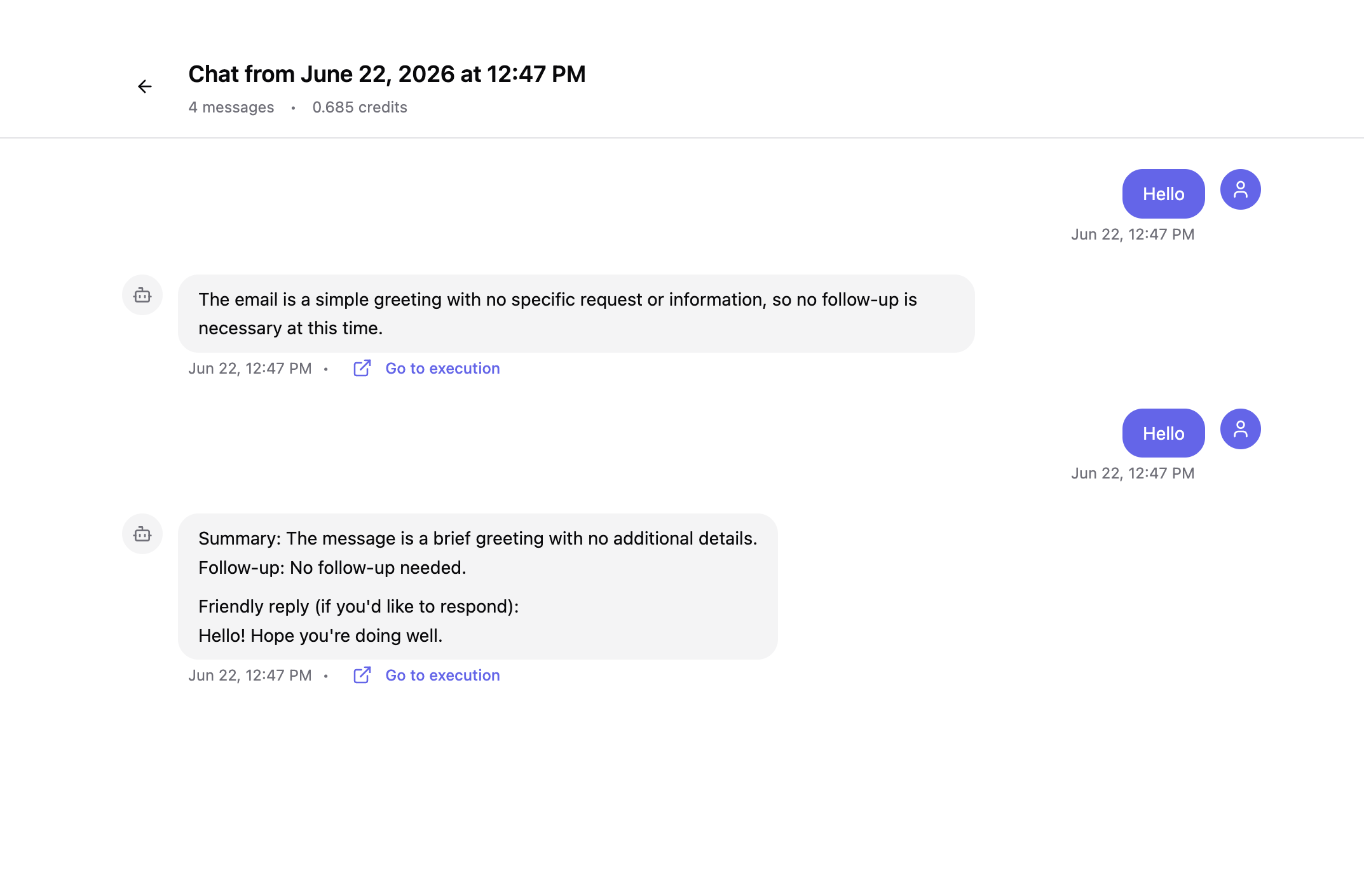
Chat-first by design
A workflow in Assemblix is something you talk to. Runs are conversational: a chat
session keeps history and state across turns, the START node can greet the user with a
first phrase, and each turn flows through your graph — agents, conditions, HTTP calls — until
an END node produces the reply.
- Voice input — the
STARTnode can accept an audio blob and transcribe it server-side (speech-to-text), so a spoken message drives the workflow just like typed text. - Voice output — an
AGENTnode can speak its answer back as synthesized audio, either buffered at the end of the turn or streamed in real time. - AI avatars — an agent's output can drive a talking avatar persona, turning a workflow into a face-to-face conversation.
Realtime voice agents
A voice agent is not a workflow: no canvas, no nodes. You write a prompt, choose a voice, and the caller talks to a speech-to-speech model directly — which is why it answers fast enough to interrupt. Workflows reach the conversation as analysis hooks: they run in the background on every turn and once at the end, scoring the call, extracting fields, or writing to a CRM.
- Voice agents — what you configure, calls, and costs.
- Providers — OpenAI Realtime vs Gemini Live, honestly.
- Analysis hooks — scoring and extracting from a live call.
- Integrating a call — the session-token + WebSocket protocol.
What you can build
Lead qualification and scoring, voice assistants that take calls, sales agents graded against your own criteria, employee training where the agent plays the customer, language practice and knowledge checks, structured interviews and surveys, and internal help desks grounded on your own documents.
What else is in the box
- Multiple LLM providers — OpenAI, Gemini, DeepSeek, with fallbacks and per-credential routing.
- Tools & MCP — give agents tools and Model Context Protocol servers to act, not just answer.
- Knowledge bases (RAG) — upload documents and ground agents on them.
- Branching & state — route on CEL conditions and read/write a shared variable scope across the run.
- Credentials & multi-tenancy — encrypted-at-rest secrets, scoped to organizations and projects.
Get going
- Get started — dependencies, the example Docker Compose files, and how to run a self-hosted instance.
- Creating workflows — the node types, how execution works, and how to debug a run.
License
Source-available under MIT + Commons Clause — free to use, modify, and self-host; you
may not sell it or offer it as a paid hosted/managed service. A small set of files
(payments / acquiring) is under a separate Enterprise license and is disabled by
default for self-hosting (BILLING_ENABLED=false). See the LICENSE.md and LICENSE_EE.md
files in the repository.